MENU
MY | MYR

MY | MYR
-
- All Centrifuges
- Benchtop Centrifuges
- Benchtop Centrifuges
- Floor-Standing Centrifuges
- Refrigerated Centrifuges
- Refrigerated Centrifuges
- Centrifuges
- IVD Products
- Microcentrifuges
- Multipurpose Centrifuges
- High-Speed Centrifuges
- Ultracentrifuges
- Concentrator
- Accessories
- High-Speed and Ultracentrifuge Consumables
- Centrifuge Tubes
- Centrifuge Plates
- Device Management Software
- Sample and Information Management
- VisioNize Devices
- GLP Products China
-
- All Pipettes, Dispensers & Automated Liquid Handlers
- Mechanical Pipettes
- Electronic Pipettes
- Multi-Channel Pipettes
- Positive Displacement Pipettes & Dispensers
- Pipette Tips
- Bottle-Top Dispensers
- Pipette Controllers
- Dispenser & Pipette Accessories
- Automated Pipetting
- Automation Consumables
- Automation Accessories
- Liquid Handler & Pipette Services
- IVD Products
Sorry, we couldn't find anything on our website containing your search term.
You are about to leave this site.
Please be aware that your current cart is not saved yet and cannot be restored on the new site nor when you come back. If you want to save your cart please login in into your account.
Sorry, we couldn't find anything on our website containing your search term.
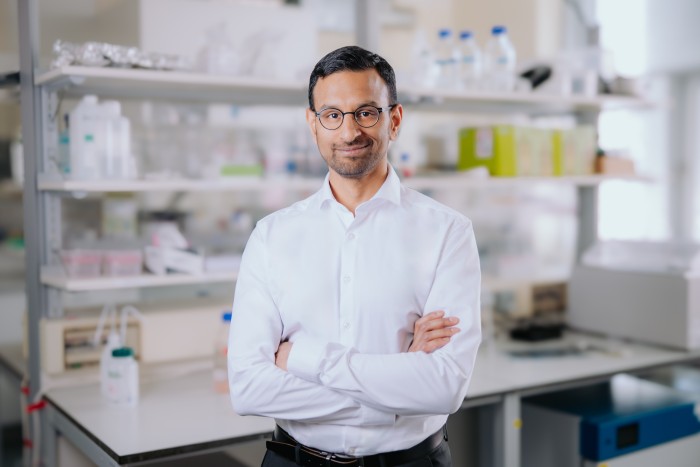
Our Strength Lies in Bold and Interdisciplinary Teamwork
Beyond Science
- Lab Life
- Off the Bench
- Bright Minds
Dr. Varun Venkataramani is the winner of the Eppendorf Award for Young European Investigators 2025. Three questions for the scientist:
In your research, you have studied how cancer cells interact with neurons and control the progression of brain tumors. What has been your most important discovery?
Dr. Varun Venkataramani: We found out that glioblastoma cells – the most aggressive kind of brain tumor – form functional synapses with neurons and, in a sense, hijack the brain’s communication system. Within these synapses, neurons release glutamate, an important neurotransmitter in the brain, and electrical impulses excite the tumor cells into growing more quickly and spreading. This discovery fundamentally changed our prior understanding because now we know that brain tumors don’t only just grow in the brain; they integrate themselves actively into its neuronal architecture and exploit it.
The jury particularly appreciates the translational potential of your work. How could the treatment of brain tumors improve in the future?
Venkataramani: We’re currently studying, in a clinical phase II trial, how the drug perampanel functions in cancer patients with glioblastoma. The drug blocks certain glutamate receptors and limits excessive brain activity in epilepsy patients, and so we presume that it may also be able to disrupt the communication between neurons and tumors. We have identified target structures in the tumor cells, certain receptors, where antiepileptics have an effect.
In addition, we’re currently developing a gene therapy process – retrograde virus tracing – to sever tumor cells from the neuronal circuits that keep them alive. Our goal is to establish this method as a real alternative to conventional treatment options. We all pool our efforts in this young field of cancer neuroscience, which I co-founded.
Behind every trailblazing discovery is a strong team. What distinguishes the research team that you’ve had your success with?
Venkataramani: Our strength lies in bold and interdisciplinary teamwork. By joining together neuroscience, oncology, modern microscopy and clinical medicine, we hit on new solutions; for example, a process that makes a modified rabies virus visible in order to show tumor networks. We’ve also further developed microscopy on living organisms, called intravital microscopy, to observe the interactions between tumors and neurons in living brains.
Thanks to global collaboration, our results can be put into practice quickly. And we promote a culture that empowers young scientists to pursue innovative, high-risk ideas. Trailblazing discoveries don’t come about in any other way.
Dr. Varun Venkataramani: We found out that glioblastoma cells – the most aggressive kind of brain tumor – form functional synapses with neurons and, in a sense, hijack the brain’s communication system. Within these synapses, neurons release glutamate, an important neurotransmitter in the brain, and electrical impulses excite the tumor cells into growing more quickly and spreading. This discovery fundamentally changed our prior understanding because now we know that brain tumors don’t only just grow in the brain; they integrate themselves actively into its neuronal architecture and exploit it.
The jury particularly appreciates the translational potential of your work. How could the treatment of brain tumors improve in the future?
Venkataramani: We’re currently studying, in a clinical phase II trial, how the drug perampanel functions in cancer patients with glioblastoma. The drug blocks certain glutamate receptors and limits excessive brain activity in epilepsy patients, and so we presume that it may also be able to disrupt the communication between neurons and tumors. We have identified target structures in the tumor cells, certain receptors, where antiepileptics have an effect.
In addition, we’re currently developing a gene therapy process – retrograde virus tracing – to sever tumor cells from the neuronal circuits that keep them alive. Our goal is to establish this method as a real alternative to conventional treatment options. We all pool our efforts in this young field of cancer neuroscience, which I co-founded.
Behind every trailblazing discovery is a strong team. What distinguishes the research team that you’ve had your success with?
Venkataramani: Our strength lies in bold and interdisciplinary teamwork. By joining together neuroscience, oncology, modern microscopy and clinical medicine, we hit on new solutions; for example, a process that makes a modified rabies virus visible in order to show tumor networks. We’ve also further developed microscopy on living organisms, called intravital microscopy, to observe the interactions between tumors and neurons in living brains.
Thanks to global collaboration, our results can be put into practice quickly. And we promote a culture that empowers young scientists to pursue innovative, high-risk ideas. Trailblazing discoveries don’t come about in any other way.
Read more
More information: www.venkataramani-lab.com/team/
About Dr. Varun Venkataramani:
Dr. Varun Venkataramani works at the Neurological Clinic at Heidelberg University Hospital on new approaches for better treatment and halting the growth of aggressive brain tumors. The neuro-oncologist co-founded a new field of research: cancer neuroscience.
About Dr. Varun Venkataramani:
Dr. Varun Venkataramani works at the Neurological Clinic at Heidelberg University Hospital on new approaches for better treatment and halting the growth of aggressive brain tumors. The neuro-oncologist co-founded a new field of research: cancer neuroscience.
Read more